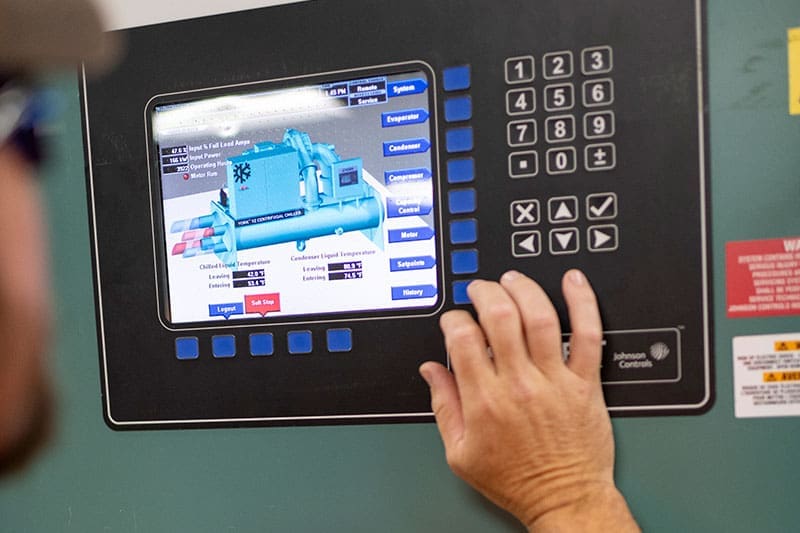
Indoor setup on site of the building HVAC Balancing and commissioning

Building Commissioning

Our Commissioning Team is ready, whether it is new construction or existing systems, we have a plan to enhance your Building.

Building Commissioning

Building Commissioning

Building commissioning is a systematic process of verifying that all building support systems have been installed and are performing in accordance with the approved construction documents.

Two men that work at SITA are working on proper installations of building HVAC Commissioning

Our team is vital in ensuring proper installation.

A man is working on building HVAC Commissioning , testing and verifcation

Unbiased testing and verification

Commissioning also ensures that all of the building’s installed equipment meets the owner’s intended operational, maintenance, and energy efficiency needs. The value of Commissioning is well documented as far as energy savings.

Organizations such as the New York State Energy Research & Development Authority (NYSERDA), U.S. Green Building Council and Portland Energy & Conservation, Inc. (PECI) have calculated anywhere between 15%-30% energy reduction for buildings that are Commissioned to buildings that are not.

The owner/operator community also realizes the operation and maintenance benefits, where the maintenance costs are reduced by 15%-35% as well.

Two men are working together an analysing the state of the building commission on site 2

5 Tips for Commissioning Success

5 Tips for Commissioning Success

The HVAC Commissioning process can be greatly enhanced by following these five recommendations.

  • Involve an HVAC Commissioning Authority early.
  • Review and ensure the HVAC Commissioning Authority holds a professional accreditation associated with HVAC Commissioning.
  • Implement Commissioning Meetings, with the designers during the design process.
  • Provide HVAC Commissioning Requirements in the bidding/RFP process of the project.
  • Include references to the HVAC Commissioning Specification in every specification section that is associated with the HVAC Commissioning Process.

Frequently Asked Questions

Frequently Asked Questions

These answers clarify what HVAC commissioning involves, explain typical costs and timelines, and demonstrate how professional commissioning protects your building investment through energy savings and reliable performance.

HVAC commissioning is a quality control process that verifies your new system works correctly before you occupy the building. It starts during design and continues through construction.

  • Phase 1: Design review (before construction)
  • Phase 2: Construction observation (during installation)
  • Phase 3: Functional testing (near completion)
  • Phase 4: System integration (final weeks)
  • Phase 5: Documentation and training (at completion)

Timeline: 3-6 months for typical commercial buildings, starting at the design phase and ending after occupancy.

Four main commissioning types serve different building needs:

New building commissioning:

  • Applied to new construction projects
  • Starts during the design phase
  • Verifies systems work as designed from day one
  • Most comprehensive approach
  • Cost: 1-3% of total HVAC installation

Existing building commissioning (retro-commissioning):

  • Applied to occupied buildings
  • Optimizes current system performance
  • Identifies efficiency improvements
  • No design phase involvement
  • Typical energy savings: 10-20%

Re-commissioning:

  • Repeats commissioning on previously commissioned buildings
  • Recommended every 3-5 years
  • Catches system drift and degradation
  • Maintains original performance levels
  • Lower cost than initial commissioning

Monitoring-based commissioning:

  • Uses continuous monitoring systems
  • Detects problems in real-time
  • Automated fault detection
  • Ongoing optimization
  • Requires a building automation system

Which type do you need?

  • New construction: Initial commissioning
  • Existing building with problems: Retro-commissioning
  • Previously commissioned building: Re-commissioning
  • Large facility with automation: Ongoing commissioning

Many Florida buildings combine re-commissioning with monitoring-based approaches for continuous performance

A 3-phase HVAC unit runs on three-phase electrical power instead of standard single-phase power. Three-phase power delivers electricity through three separate wires carrying alternating current.

Important: You can’t run 3-phase equipment on single-phase power, and vice versa. Check your building’s electrical service before purchasing HVAC equipment.

Most commercial buildings in Florida use 3-phase power for rooftop units and chillers. The utility company determines what’s available at your location.

Professional testing and balancing directly impacts how much you spend on energy every month.

Energy waste from unbalanced systems:

Unbalanced HVAC systems waste 20-40% more energy. Here’s why:

Problem 1: Equipment runs longer

  • Hot spots never reach the temperature
  • System runs 14-16 hours instead of 10-12 hours
  • Extra runtime = wasted energy

Problem 2: Simultaneous heating and cooling

  • Over-cooled zones trigger reheat
  • The system heats and cools at the same time
  • Wastes 15-25% of energy

Problem 3: Poor humidity control

  • Improper airflow prevents dehumidification
  • The system overcools while trying to remove moisture
  • Energy use increases 25-35%

Problem 4: Equipment strain

  • Unbalanced pressure stresses motors and compressors
  • The equipment works harder than necessary
  • Efficiency drops 10-15%

Why professional certification matters:

Certified technicians use calibrated instruments that measure accurately. They follow industry standards ensuring consistent results. You get documented proof your system performs efficiently.

Non-certified testing often misses problems or creates new ones through improper adjustments.

Long-term impact:

Proper balancing saves money every month for the entire life of your building. A $12,000 TAB investment that saves $15,000 annually pays back in under one year and continues saving for 15-20 years.

Professional commissioning firms provide expertise that protects your building investment.

  • Benefit 1: Catch problems before they’re expensive
  • Benefit 2: Verify you get what you paid for
  • Benefit 3: Reduce energy costs from day one
  • Benefit 4: Extend equipment life
  • Benefit 5: Smooth occupancy transition
  • Benefit 6: Warranty protection
  • Benefit 7: Code compliance assurance
  • Benefit 8: Training and documentation

Cost vs. value:

Commissioning costs 1-3% of HVAC installation but delivers:

  • 10-20% energy savings (ongoing)
  • Fewer equipment failures
  • 3-5 years additional equipment life
  • Reduced maintenance costs
  • Better tenant satisfaction

ROI typically ranges from 2-5 years, with benefits lasting 15-20+ years.

For Florida’s demanding climate, professional commissioning is essential for achieving designed performance and controlling long-term operating costs.

Benefits of Building Commissioning

Building HVAC Commissioning benefits include: enhanced building performance, lower operating costs, and greater occupant comfort. Building owners and managers, from government facilities to private owners, are incorporating Commissioning into their new building or retrofit projects in order to minimize their energy usage and operational costs. In essence, HVAC Commissioning helps building owners ensure that:

  • Proper project closure has been attained for all construction activities.
  • Post-construction operating and maintenance costs have been minimized.
  • Building occupant complaints have been reduced to minimal.
  • Building has been constructed and is operating as intended.
Two men are working together an analysing the state of the building commission on site

Have Any Questions?

Have Any Questions?

We encourage questions and are happy to answer them! You can send your inquiries through our Contact page